For inquiries related to order or shipping, please contact us at contact@animalhospital.store

The Mimic Patient is an Anomaly designed to make a suspicious patient look familiar. Community guides describe Mimics as copycats that can imitate the appearance of patients or recurring characters you have already seen.
That makes recognition unreliable on its own. A patient may look like an animal you remember and still require a full inspection before admission.
The safest approach is to compare the patient’s live appearance, developed photo, and CCTV footage. When the encounter involves a familiar recurring character, memory can also help you spot differences that are easy to miss at first glance.
The exact Mimic mechanic is not described identically across all community sources. Some guides describe Mimics as copying previously seen patients, while others focus on recurring characters or specific camera behaviour. These descriptions should therefore be treated as related community reports rather than one completely confirmed mechanic.
Animal hospital mimic patient: what the copying mechanic does
Community sources generally describe the Mimic as an Anomaly that copies something familiar instead of immediately showing an obvious abnormality.
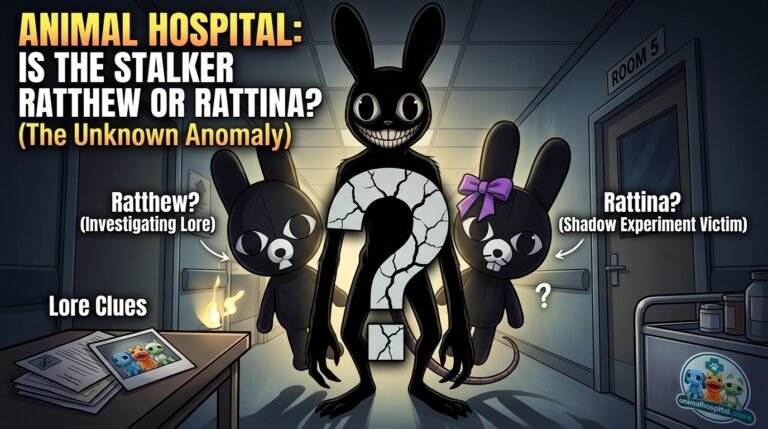
One community wiki describes Mimics as copycat Anomalies that imitate patients who have already appeared. Another guide gives recurring characters such as Ratthew as an example, where the player is expected to notice that the familiar character does not look exactly as it normally does.
The wording differs between sources, so it is not clear whether these descriptions refer to one Mimic mechanic, different variants, or terminology used differently by individual guides.
The consistent warning is more useful than the exact label: a familiar-looking patient should not automatically be treated as genuine.
Instead of asking only whether you recognise the animal, check whether its visible details actually match what you remember. Small differences can matter, particularly when the patient resembles a recurring character.
Why a familiar patient can still be an Anomaly
Most players naturally use recognition as a shortcut. If the animal looks like one that has already been treated, it feels less suspicious than a patient with an obvious visual defect. The Mimic uses that expectation against you.
The community wiki says the copy can defeat “autopilot”: the habit of opening the shutters after only a quick look. This is a confirmed description of the wiki’s explanation, not proof that every familiar-looking patient is a Mimic. A normal patient can still look normal. The useful distinction is that normal appearance alone does not settle the case.
That matters because the three routine checks examine different kinds of evidence:
- Appearance: what you can see at the window, including eyes, teeth, ears, posture, and movement.
- Photo: whether the developed photograph matches the live patient.
- CCTV: whether the security feeds show something the reception view does not.
The patient guide recommends running these checks before admission. It records the workflow as appearance, photo, and CCTV, with different anomaly types exposed by different checks. That makes the workflow useful against a copied patient even when no single clue identifies the threat.
How to check a suspected Mimic before admission
Use several sources of evidence instead of relying on recognition alone.
Start with the live appearance: Check the patient’s eyes, teeth, ears, posture, movement, and other visible details. If it resembles a recurring patient or character, compare those details with what you remember rather than accepting the familiar appearance immediately.
Develop the photo fully: Take a photograph and wait for it to finish developing before comparing it with the live patient. Community guides include photo comparison as part of the normal Anomaly-checking process, although the available sources do not establish that every Mimic must reveal itself through a photograph.
Check CCTV: Security footage provides another view of the patient and can reveal behaviour or changes that are not obvious at the reception window. Some community reports specifically describe Mimic-like behaviour that becomes clearer through camera footage.
Use memory when the patient copies someone familiar: If the visitor resembles a recurring character such as Ratthew, compare its appearance with the version you have previously seen. This is especially useful when the difference is subtle rather than an obvious visual mutation.
No single check should be treated as a guaranteed Mimic detector. The safest routine is to compare the available evidence before admission, especially when something about a familiar patient does not match your memory.
What happens if you admit the wrong patient?
The official Roblox game listing describes Animal Hospital (Anomaly) as a night-shift patient-treatment game where some patients behave strangely. Community patient guides add that admitting an Anomaly can drain sanity, turn hostile, or trigger a more dangerous event inside the hospital.
A separate guide reports that the Mimic or Skinwalker disguise may transform after admission, during treatment, or during recovery, and may attack nearby players or patients. This is a community report, so the exact timing should not be treated as universal or guaranteed for every Mimic encounter.
The practical consequence is still clear: the danger does not necessarily end when the patient reaches the treatment area. If the visitor passed only a quick window inspection, the admission decision was made with incomplete evidence.
That is why Mimics matter when checking for Anomalies. They make a familiar patient look like a safe patient, then move the risk past the point where players expect the inspection to be finished.
What the sources confirm, report, and leave unknown
| Question | Evidence status | What can be said carefully |
|---|---|---|
| Can a Mimic copy a patient or familiar character? | Confirmed as a community-wiki description | The community wiki describes Mimics as copycat Anomalies that imitate patients already seen. Another guide gives recurring patients such as Ratthew as an example. |
| Will every Mimic look wrong in the photograph? | Unknown | The wiki recommends photo comparison, but the available material does not establish that every copied patient must fail the photo check. |
| Can a Mimic appear normal before admission? | Community-reported | Guides describe the disguise as normal-looking or familiar at the window. This is the central warning of the mechanic, but it is not a guarantee about every encounter. |
| Does the Mimic always transform at one specific moment? | Unknown | One guide reports transformation after admission, during treatment, or during recovery. The sources do not establish a single fixed trigger. |
| Is the Mimic Patient a separate mechanic from other Mimic descriptions? | Unknown | The sources use overlapping terms but do not settle whether they describe one Anomaly, multiple forms, or different guide terminology. |
A short Mimic check for busy Shifts
If you need a compact routine, use the same order for every suspicious patient:
- Look at the live patient for more than a quick species check.
- Compare the details with the patient or recurring character you remember.
- Take the photo and wait for it to develop fully.
- Compare the photograph with the live view.
- Check CCTV before opening the shutters.
- Keep the patient under suspicion if the evidence conflicts or your memory does not match.
This is not a claim that every Mimic has the same tell. It is a way to avoid relying on the one piece of evidence the copycat is designed to exploit: recognition.
Is the Mimic Patient the same as a Skinwalker?
The available community guides use “Mimic” and “Skinwalker” in related descriptions, but the sources do not establish a definitive naming rule. One guide discusses a Mimic or Skinwalker disguise that can transform after admission, while another separates the Mimic Patient as a memory-based identity Anomaly.
For a Shift, the label matters less than the behaviour being described. If the patient looks like a familiar animal or recurring character, use the full inspection routine. If a guide says the form can appear normal until later, do not assume that a clean reception view proves safety.
Related merchandise
The store has a Mimic plush toy listed for readers who collect merchandise connected with the game’s Anomalies. The product listing is separate from the gameplay evidence above and does not establish anything about how the Mimic works in-game.
Sources and verification
Last verified: 18 Sep 2026.
Each row below says what the source was used for and how the page was read. A row marked as a search summary was not opened in full, so it was not treated as independent confirmation.
| Source | Type | What we used it for | Checked |
|---|---|---|---|
| Animal Hospital — Roblox listing | Platform listing | Official Roblox listing for Animal Hospital (Anomaly), describing the night-shift hospital gameplay and patients that may act strangely. | 17 Sep 2026 — search summary only, page not opened |
| Animal Hospital Patients Guide — Genuine vs Anomaly | Independent secondary guide | Explains the three-check workflow: inspect the patient at the window, develop and compare a photo, and review CCTV before admission. | 18 Sep 2026 — full page |
| Animal Hospital Mimic Patients — Copycat Anomalies | Independent secondary guide | Describes mimics as copycat anomalies that imitate patients already seen, exploit player autopilot, and may be exposed through full inspection or photo comparison. | 18 Sep 2026 — full page |
| Mimic Patient (Anomaly) | Animal Hospital Wiki | Independent secondary guide | Documents a memory-based Mimic Patient that copies recurring NPCs such as Ratthew and may require comparing subtle physical details against memory. | 18 Sep 2026 — full page |
| Mimic Anomaly — Animal Hospital Roblox | Independent secondary guide | Describes a camera-focused Mimic whose monstrous form may appear on CCTV while the window view and photo look normal. | 18 Sep 2026 — search summary only, page not opened |
What to Remember About Mimic Patients
The Mimic is designed around familiarity, so recognising a patient is not enough to confirm that it is genuine. Check the patient’s appearance carefully, compare the developed photo, and review CCTV when needed.
If the patient resembles a recurring character, compare it with what you remember as well. The exact behaviour of Mimic variants can differ across community reports, so specific transformation details should be treated cautiously.
The simple rule is: a familiar-looking patient still needs to be verified before admission.